

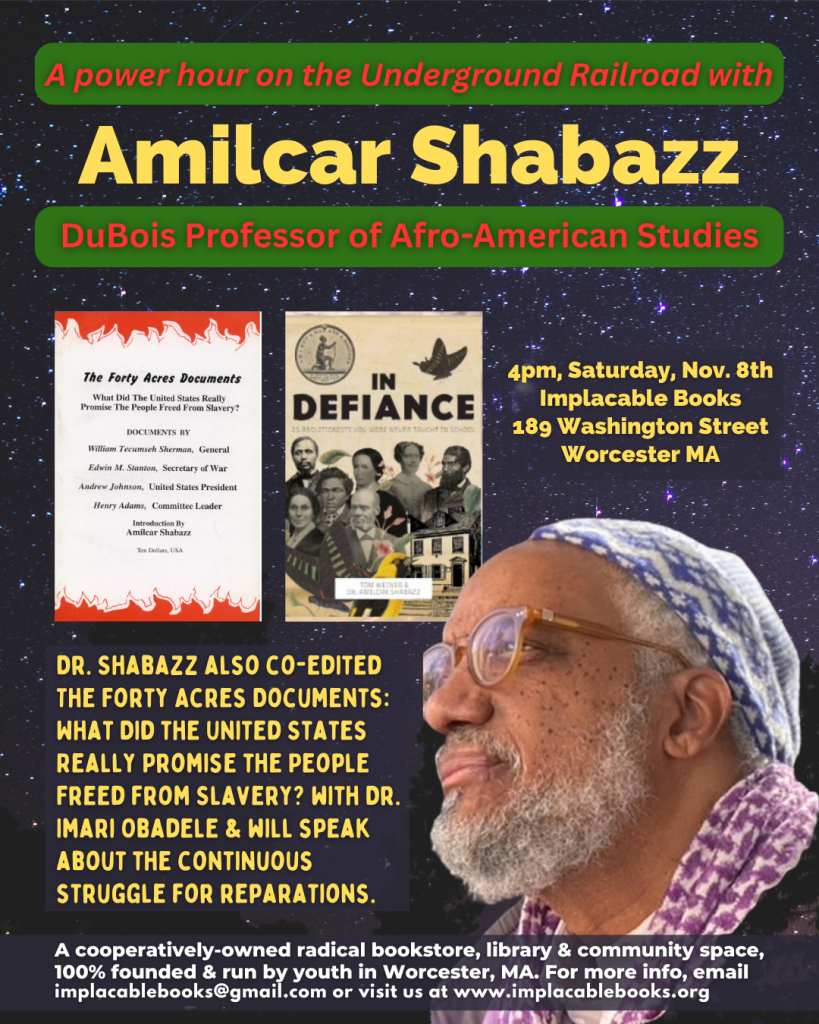
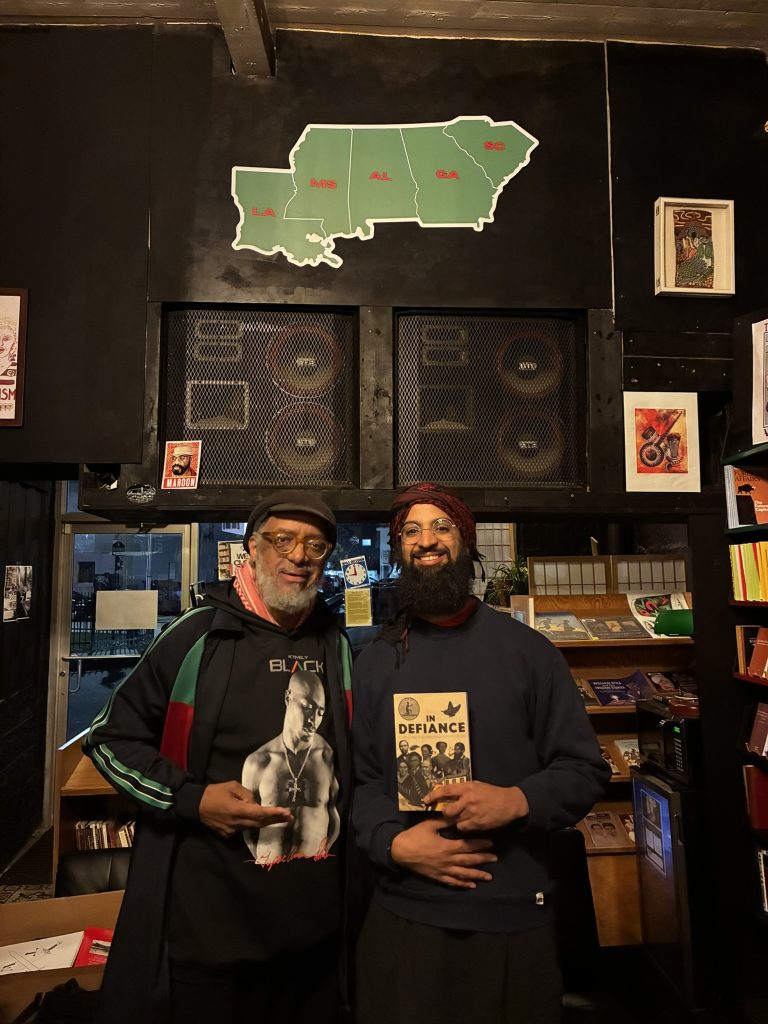
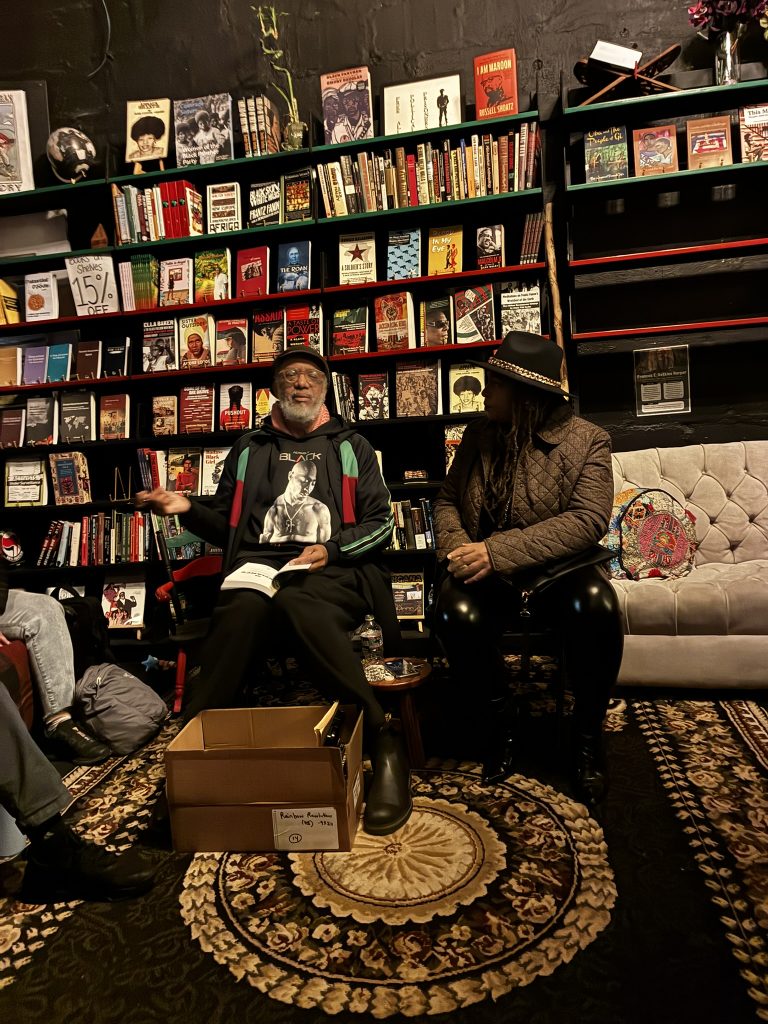
On November 8th, Dr. Amilcar Shabazz, conscious citizen of the Provisional Government of the Republic of New Afrikan and W. E. B. Du Bois Professor of Afro-American Studies at the University of Massachusetts Amherst, joined us at Implacable Books as part of his “Underground Railroad book tour.” He names it that because he feels like a “fugitive scholar” moving from place to place to teach a history that is targeted for censorship by bills introduced in roughly forty states. He asked the audience directly if we are now living in a country where the lie is legal and the truth is illegal, an offense. It is a real question.
The history in question is the history of Our People, Ourstory, shaped through the dialectic of oppression and resistance, and forged as a new nation denied the right to self-determination. It is a history repeatedly diverted into struggles for “paper” reforms that never address the central contradiction. At the heart of this contradiction is the difference between the material reality of national oppression and the ideolgical construct of race. This is the terrain opened by what has been called New Afrikan Political Science (NAPS), a method of inquiry that reveals the structural truth beneath the racial narrative.
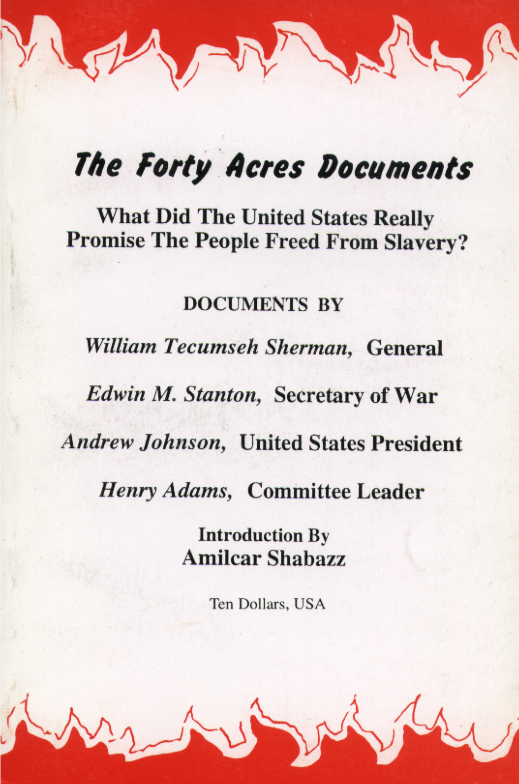
Although the struggle is broader and deeper than any single theme, one of the clearest entry points into that broader discussion is reparations. Reparations formed the core of Dr. Shabazz’s talk. The demand remains alive today, and one of the earliest scholarly attempts to document its history is Shabazz’s own work, The Forty Acres Documents. The piece presents primary documents and a critical history of the political, social, and ideological struggle to implement a reparative solution to the contradiction created when a people defined and produced by total subordination were suddenly told they were “free” to compete in a society built on four hundred years of their unfreedom. Material contradictions do not dissolve through hand waving.
Dr. Shabazz introduced our community to several key concepts within New Afrikan Political Science: the New Afrikan Independence Movement itself, the meaning of paper citizenship, the question of a national plebiscite, the distinction between national oppression and racial discrimination, and the reality that we are a nation at war. He equips us to avoid the pitfalls of symbolic or reformist detours. As Dr. Shabazz’s namesake Amilcar Cabral taught, we must claim no easy victories.
He traced the core question of the New Afrikan Independence Movement: why have the harms of national oppression in the form of slavery never been repaired. His answer is direct. We have lacked sufficient power and unity, and we have lacked sufficient allies. He highlighted the present day difficulty of even teaching or speaking about these questions, showing how censorship, repression, and fear produce a political climate where acknowledging the existence of a war on our people is more taboo than the war itself.
He examined contradictions within Juneteenth, shared material histories of have proving Black capacity and desire for independence, and traced the political struggle inside the United States government over what, if anything, would be granted to the formerly enslaved. His framing of the civil rights era as a struggle to make paper citizenship real reveals that our core issue has always been national oppression, not simply legal exclusion.
Dr. Shabazz also grounded the discussion by highlighting Belinda X, a local New Afrikan woman who made history in 1783 the earliest documented petitioners for reparations (see video below), and by lifting up Henry Highland Garnett, an abolitionist whose arguments prefigure later figures like Assata Shakur and Malcolm X.
The through-line of his talk emphasized the need to tell the truth and to watch how people and institutions react to that truth. We must find and build spaces where truth can be spoken without fear, and protect those spaces. We must move forward with clarity, refusing to be misled or to mislead ourselves. We must plug into our community and join Dr. Shabazz and others in an intellectual, social, and political underground railroad.
After his formal lecture, Dr. Shabazz stayed with us for several more hours, sharing food from Gold Coast Catering and engaging in open dialogue. The questions ranged widely. How does the New Afrikan Independence Movement relate to global struggles against US imperialism? How should the grievances of other oppressed peoples be understood without allowing the specificity of our struggle to be dissolved or turned into a cipher for the problems of the world? The danger he flagged echoed the history of the African Blood Brotherhood, which upheld the importance of autonomous New Afrikan organizations until it was absorbed into the Communist Party in the 1920s, leaving Black liberation sidelined for decades.
This transcript below the video clips captures the richness and clarity of Dr. Shabazz’s talk. It is offered as part of our own commitment to truth telling, to building political education, and to advancing the collective struggle for New Afrikan liberation.
Listen to Dr. Shabazz introduce and read on Belinda X’s petition for reparations submitted to the Massachusetts General Court in 1783. Belinda Xs 1783 petition is widely considered the first successful case of financial reparations for enslavement granted by a legislative body in what became the United States.
Dr. Amilcar Shabazz responds to a complex question regarding the relationship of New Afrikans’ demands for reparations with that of other oppressed nations exploited by US Imperialism and how those contradictions are playing out in Massachusetts today. Read full transcript below
Start of Transcript:
“It is our duty to fight for our freedom…to win, and to take care of one another.” [Call and Response]
This afternoon I would just like to take a moment to briefly talk about the struggle for reparations, particularly here in North America, in this place we call the United States of America. In the New Afrikan Independence Movement (NAIM), I think it was a brother named Anwar Prashad who would frequently say “the United Snakes of America,” because certainly we live in a time and a place that is very precarious for the lives of people, and in that sense of precarity, of the snakes, if you don’t know where they’re coming from, it can very much be thought of as the United Snakes of America.
We have been at war for a long time in this country. And as I wrote, when Dr. Imari Obadele asked me to prepare an introduction for a collection of documents that we worked on together, which we called The Forty Acres Documents, one of the things I tried to address in the introduction was this idea: Why did we never get our reparations? Why, even today in this country, in this place, has any effort to acknowledge the harm of slavery and to repair the harm of slavery never occurred?
From all my studies and all my knowledge of history, [the answer] is that it’s a matter of this war that I’m speaking of, and the fact that we have never had the sufficient organizational power, the sufficient unity, and the sufficient number of allies to be able to win our reparations.
People ask me, what is this thing called reparations? And I often tell them: reparations is as old as human conflict, okay? You and a friend have a big argument, you get mad at each other, bad words are said, but then later you come back around, you talk it through, you process it, you reach a détente, you reach some understanding. And then what do you do? You try to repair your relationship. And perhaps some reparations are involved depending on the nature of the conflict or whatever happened. So reparations are as old as human conflict.
We are taught that the conflict of people of African descent in this country was resolved, was figured out and settled, in favor of those who had been enslaved, the people of African descent who’d been enslaved, somewhere in and around Juneteenth, 1865. The nineteenth of June, 1865, sort of marks the moment in which we agreed that what had happened in the past was wrong and that we would move forward in some new direction, particularly in the direction where the people of African descent were no longer to be enslaved, were to be free men and free women. the Free People.
But truth be told, the Free People never got reparations. There was an organization set up briefly at the end of the Civil War, actually, it even began working when they started capturing territory before the war was ended, such as in South Carolina at Port Royal. It became known as the Port Royal Experiment. Could Black people, if set free, if made free, work the land without white supervision, white control, white authority over them, overseers and all of that? Could they, on their own, plant a cotton crop, bring in the cotton crop, and be productive without white supervision and white control? And the experiment was very successful. The people showed them that yes, being free and on our own land, and knowing that we would share equally in whatever surplus value was produced from it, we would lal enjoy together and work productively. That was the beginning of the Freedmen’s efforts toward repairing the condition of the Free People.
After the Civil War, Congress funded something called the Freedmen’s Bureau of Abandoned Lands and Refugees, it had a very long title. But this agency of the government was supposed to bring about repair, the reparations. And W.E.B. Du Bois, if you’ve ever read The Souls of Black Folk, that great classic, devotes one of the chapters to assessing it. The book came out in 1903, some forty years after the Emancipation Proclamation, and it attests to how important that agency was, that he would focus a whole chapter on trying to understand what happened. He goes into it very carefully. Later historians, no one has ever refuted the basic analysis that he makes. I’ll shorten it by saying that fundamentally, the only truly beneficial outcome of the Freedmen’s Bureau, in the short period that it existed, was that it began to establish schools for the children of the Free People. Schools did begin to crop up and get organized. Teachers, mostly white, mostly from Canada and the northern states, came down, because only one out of ten people of African descent had any rudiments of literacy. Ninety percent had absolutely no literacy at all. So you had to rely on people who could read and write and teach. It was the one thing out of the Freedmen’s Bureau that had some lasting, sustainable, positive impact.
Otherwise, the idea of capital formation, the idea of finding a way to integrate the Free People into American society, was a failure across the board. Criminal justice, getting a fair shake in the courts, no. Land transfer or land redistribution, no. Basic help in preventing starvation in certain areas, a little bit, but overall it was not successful. Du Bois analyzes all of this.
And of course, when it was set up, it was established with a very short span of funding in the federal budget. When it came up for renewal, Lincoln had been assassinated and Andrew Johnson was the president, the same one who would later be impeached. He vetoed it when it came before him. He said, “Nope, we don’t need this, this is not right.” One of the documents in The Forty Acres Documents is his written explanation of that veto. He wrote it out. It’s an interesting document to read, to see the mindset of the chief executive of the Settler Colonial Government of United States as to why there should be no Freedmen’s Bureau, which, in effect, is why there should be no reparations.
His veto was overridden, and the Freedmen’s Bureau continued for a brief period longer. But by 1869, the Freedmen’s Bureau was over. Going into the 1870s, the efforts to bring about some serious form of repair, payment of reparations, land redistribution and the things that should have happened, were gone. And by 1876, with that election and the aftermath, the Hayes–Tilden Compromise and the pulling of the troops from the South, the window for any kind of reparative justice for the Free People was closed out. It was over.
And in effect, a new form of slavery, or a continuation of slavery by another name, if you wish, is what happens from the 1860s down to the 1960s. We’re back pretty much in the same boat. The only difference is that we have these amendments to the Constitution that supposedly say we are citizens, we are no longer slaves, slavery is no longer the case, and we are now citizens with equal protection of the law, and, thirdly, that the men, and later women, are entitled to vote.
These we often refer to in New Afrikan Political Science (NAPS) as paper amendments, paper citizenship. On paper it says we’re this, but in reality we’re not. And that long fight to become what the paper says becomes the long civil rights movement. In 1900, Du Bois announces it when he says that the problem of the twentieth century will be the problem of the color line. He goes on to found the Niagara Movement. They go on to later create the National Association for the Advancement of Colored People, and this long battle in the streets, in the courtrooms, in the boardrooms, in all kinds of arenas, is the fight to make those paper amendments be real in some form.
And we can say, yes, with the passage of the Civil Rights Act of ’64, the Voting Rights Act of ’65, and certain efforts on the part of the federal government, there is finally at that point an effort to make those paper amendments real.
Two problems with that. One is that we were never given the plebiscite. We were never given the vote to say: we, the Free People, what is it we want? We were just told, “This is what we’re doing.” We’ve never been allowed to exercise our own voice, our own say-so.
So that’s the first problem with this walk-through history I’m giving. The second problem is that even when we are instantiated with this supposed full citizenship, the problem remains that we are an oppressed nation. We are a national minority. We are such a small subset. I show my students: in 1940, the population of the United States was essentially ninety percent people classified in that census as white. 9.8 percent, something along those lines, are classified as Black, and a fraction of one percent is everybody else, the Native Americans, Asian Americans, you name it. Everybody else is a fraction of one percent.
So when people talk about the Black–white binary and say, “Oh, you need a more expansive view,” in 1940, there was no expansive view. This was a Black-and-white apartheid nation. I’m not denying there weren’t other people; I’m saying numerically that’s what the numbers had dwindled to. And some of that “Black” category included many Indigenous people who had been pushed, forced into denying their indigeneity and found themselves in the Black community.
One of them was a colleague of mine at UMass. I first encountered him through a 1960s essay in a book edited by Addison Gayle called The Black Aesthetic—beautiful, powerful essays about Black culture and the Black experience. When I got to UMass, I was excited: “I’m finally going to meet Ron Welburn, this great Black cultural aesthetic theorist from the sixties.” And I get there and he’s like, “No, bro, those Black days are over for me.” I said, “Really?” He said, “Yes. I have an Indigenous identity that was taken from me, and I’m now finding my way back to it.” And he began doing that. I’d see him at the Powwows, I’d read his work, and I began to understand. That was important for him, to move back in the direction he had been cut off from.
So that’s just where the world was at the middle of the twentieth century. White people nine out of ten, Black people one out of ten, and “other.” And we simply found ourselves without the power, without a significant enough number of that ninety percent white population supporting reparations or supporting something fundamentally different for us. It’s hard to do otherwise.
People I learned from, like Imari Obadele, if you ever read his War in America and you see where his mind was in ’65 and ’66 after Malcolm died, the great hope in that document War in America is China. Communist China. “Let’s form an alliance with Communist China to possibly break free in this prison house of nations and get our self-determination. China will back us.” Why did they put so much hope in China? Because in 1964, China conducted its first nuclear test, detonating a nuclear bomb. It became a nuclear power in 1964. So they’re like, “Whoa. If they’re a real ally…” And Robert Williams goes over there, our first president of the Republic of New Afrika in exile. And the hope is: if Rob can bring Mao and the Chinese people over to real support of us, maybe we can get a different shake here. Maybe we can get a plebiscite. Maybe we can exercise our voice in terms of self-determination. Maybe we can get reparations. It was born out of that moment, from what I can read and understand.
But all this to say, and where I want to tie this up, is that this kind of history, talking in this sort of way, is like being on the Underground Railroad in 1843. That’s how I feel about it. That’s why I call my moving around “Underground Railroad talks,” and my Underground Railroad book tour. Because I feel like a fugitive scholar going around talking this kind of history.
Last night, we were in Keene, New Hampshire. an all-white audience. Before that, earlier, I was at Trinity College in Connecticut. And these white people are like, “What is this man talking about? Reparations? What is this man talking about, these people … abolitionists?” And I have to stop and let them know: over the last three or four years since George Floyd, Breonna Taylor, all of that so-called awakening, America “got woke,” the very next year, 2021, different states started putting forward legislation to control the teaching of history. That there’d be no real Black history, no real Indigenous history, no real truthful history at all.
Forty-four states have had bills introduced. About eighteen have passed these kinds of bills. My home state of Texas has passed a bill like that, banning books like this. If a teacher goes into a school and they see a book and decide, “This is divisive. This is critical race theory. This is something negative. This makes white folks feel bad,” they can get it pulled from the school and possibly get the teacher fired.
This is how critical it is. In Alabama, where I taught for eight years, I don’t know that I can go back. Writing stuff like this, they passed a bill declaring any kind of teaching of “divisive knowledge” or “divisive topics” forbidden. If it’s “divisive,” you can be fired. It’s not allowed.
One of my colleagues from when I was at the University of Alabama, she’s in the School of Social Work, has sued against that legislation. Her name styles the lawsuit. Her name is Cassie Simon, or Cassandra Simon. She is a cousin of my late wife. They found out that when we all met each other, they’re third cousins. She is the lead name on the lawsuit. So it reads Simon v. Ivey, for Governor Kay Ivey, the Governor of Alabama who signed it into law. And it essentially says what I’ve said: that if you teach anything divisive, racially divisive, then you are against the law. You are in the wrong. You have broken the law. And so it’s working its way up the courts. We’re going to see what happens with that with this Trump Court we have, the Roberts Court. How far will it go? If the First Amendment rights, freedom of speech and academic freedom, are really at this point where the lie is legal and the truth is illegal, is an offense… is that really where we are?
And so, for me, this kind of teaching, this kind of work, and I have to say, of the five or six states in the United States that have had no bill introduced by any of these MAGA legislative people that are bought by the billionaire class to do this, because that’s how it got into forty-four states, rich people had a little think tank group write up what the legislation should look like, then mail it out with money for lobbyists to get some legislator somewhere to introduce it and try to get it passed, Massachusetts is one of them. No such bill has been introduced in Massachusetts.
Where we were last night, in New Hampshire, it did pass in 2021, and they are fighting it now. There are efforts to fight it, but the governor then, Chris Sununu, signed it into law, that no teaching of racially divisive topics is allowed in New Hampshire. That’s right next door.
So there’s a lot of work to be done.
[…Recording breaks off…]
But I’m saying I don’t want you to just go back to the status quo antebellum, or how it was before Trump. We need to go further. We need this truth-telling that can open the minds of the people to understand the truth about the reparations we are owed, and why it’s going to come from that truth-telling.
This is the kind of instruction we give. I’m not worried about being “divisive,” because I’m not trying to be divisive. Nothing we teach is about trying to be divisive. It’s about trying to tell the truth, because ye shall know the truth, and it will what?
[Speaker changed]
Set you free.
[Speaker changed]
It will make you free.
So let me just give a little bit from this book, and then we’ll open up for some conversation. Chapter One is entitled Belinda X. and the Fight for Reparations. And we provide in the appendix one of her petitions. This is Belinda, one of her petitions, and because she was illiterate, other people wrote it out and turned it in for her. She is one of the earliest cases we have of an Afrikan in this country asking for reparations. One of the things that blew me away about it, I’ve been trying to understand African spirituality, African religions, for a long time, and one of the words we read about is O.R.I.S.A. Anybody know how to pronounce that?
[Speaker changed]
Orisha.
[Speaker changed]
And so I’m hearing this “Orisha, Orisha,” and here I am reading the actual document, you can look at it yourself, it’s over at Harvard in the law school library, and it’s spelled out O.R.I.S.A.
So let me give you a little of her petition. It’s believed that Prince Hall is the one who might have helped her write it out.
[Dr Shabaz reads excerpts from Chapter 1 of “In Defiance”]
So, twelve years old, taken out of Ghana near the River Volta, ripped away from her parents, sold into bondage, sold into slavery. And from there she is removed from that continent, removed from the Orisas, removed from everything she knew. She is given a name like Belinda, that wasn’t her name, given a surname and a sense of being branded from the name of a man named Isaac Royal.
His property is about an hour from here, in Medford. You can go there now. It’s called the Isaac Royal House and Slave Quarters. Belinda lived there. If you read their website, they’ve begun to really acknowledge the story of the enslaved people, and of Belinda, in a way they hadn’t before, but that they are doing now.
[Gap in recording]
So all the surplus value she helped to create over fifty years of service enslaved to the Royals. She doesn’t get a morsel by the law of the land.
[Gap in recording]
So that’s just a little taste of one of the chapters. We try to make the point that many of us first learned about this through Ta-Nehisi Coates. He wrote an essay in The Atlantic called “The Case for Reparations” back in 2014. But in his essay it’s just a little part of a paragraph. So we thought we could expand it: we could show you the petition itself and allow for a deeper study, a deeper dive into this powerful case for reparations.
The other chapter I’ll end with here is on Henry Highland Garnet. We have twenty people in the book, ten white, ten Black; ten women, ten men. And Henry Highland Garnet is one of the most important for me, in the sense of my own political awakening. We titled this chapter “Henry Highland Garnet Before Malcolm X.”
When I would read and learn about Malcolm, and read the earliest communiqués after Assata Shakur was broken out of prison in 1979, she was the soul of the Black Liberation Army, and the BLA had communiqués coming out from people like Jalil Muntaqim, who is out now, I would read how they explained why the BLA as a clandestine force had been created, what its mission was, what it pledged to do, and how it was accountable to the people.
[Dr Shabaz reads excerpts from “In Defiance”]
One of the things those documents did was give us a different history of ourselves as enslaved people in this country. And Henry Highland Garnet, in this speech from 1843, does something very similar. When I read it, I said: This is what I was reading in the 1970s after Assata was broken out in ’79. He’s doing the same analysis in 1843.
What he essentially shows is that we resisted enslavement.
We didn’t accept it.
We didn’t take it.
We didn’t benefit from it.
It wasn’t, as the Governor of Florida recently said, a “job skills program” we were happy with because it taught us good skills. It was something hated. It was something we fought against. And every time we fought, we won more ground; we came closer to emptying the institution of slavery.
Just to give you a taste from this speech: one of the things he says is that all the other Black abolitionist speeches in those conventions were always addressed to other free people. “Oh, how terrible slavery is, look at what we’re doing, we need to stop this.”
But in this speech, Garnet says:
I don’t want to address other free people.
I want to address the enslaved.
To tell them what we think about the condition they’re in, and what we support.
He goes on from there to say this.
Henry approached the end of his appeal. Yes, in my words, it was similar to what David Walker did in his own Appeal, looking to the future and asking, “When and where will the demands of the reformers of this and coming ages end?” And again he answered his own question: Emancipate. Enfranchise. Educate.
The difference this time, an essential difference for understanding his intent, was that he was not demanding that the enslaved “arise, arise.” At this point he was demanding that white America support Black America in its efforts to win its freedom by any means necessary.
[Gap in recording]
And here is the point I wanted to make from the address:
So if we could revise that to now, maybe we really can get reparations, and get the change and transformation that is necessary and that is due. But it’s only going to be from our own efforts. As we said back in the day: We are our own liberators. That’s what this is really about. If we can tell the truth, and get true allies to our cause, I think we can make a difference.
Thank you all for having me.
Leave a Reply
You must be logged in to post a comment.